

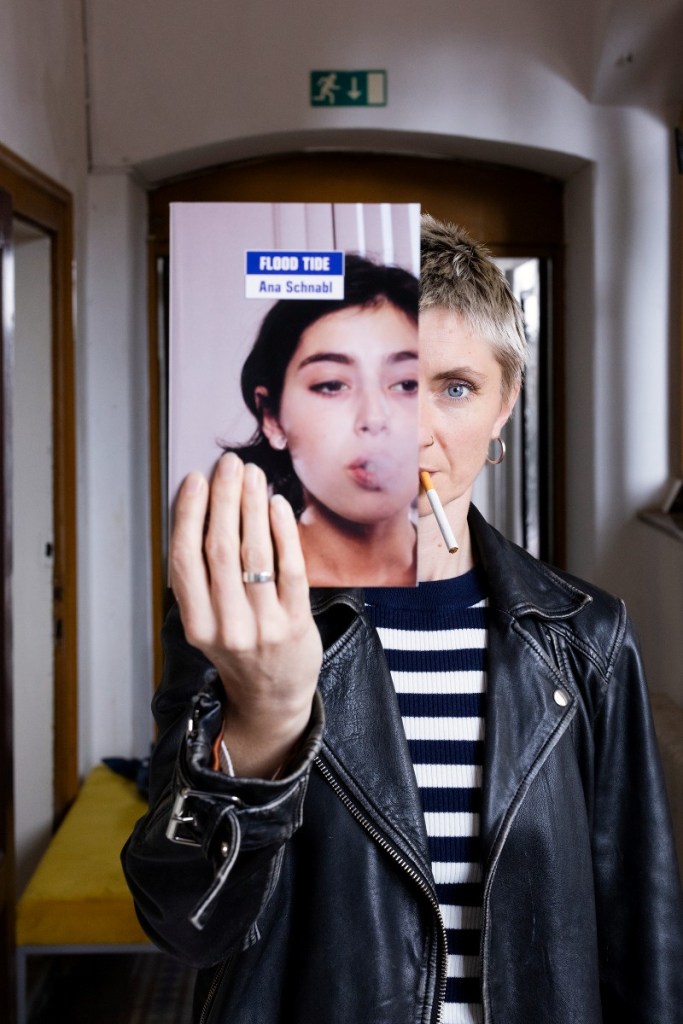
Photo of Ana Schnabl by photographer Matjaž Tančič
Ana Schnabl discusses with Ivan six things which should be better known.
Ana Schnabl is a Slovenian writer and editor. She writes for several Slovenian media outlets and is a monthly columnist for the Guardian. Her collection of short stories Razvezani (Beletrina, 2017) met with critical acclaim and won the Best Debut Award at the Slovenian Book Fair, followed by the Edo Budiša Award in Croatia; the collection has been translated into German and Serbian. Three years later Schnabl published her first novel Masterpiece (Mojstrovina, Beletrina, 2020). She toured Europe with the English, German and Serbian translations of the book, which included a residence in the Museumsquartier in Vienna, the Literarisches Colloquium Berlin, and the first European Writer’s Festival in London. The novel was given favourable reviews and mentions in numerous Austrian, German and English media, and was longlisted for the Dublin Literary Award. Her second novel Flood Tide (Plima, Beletrina, 2022) was nominated for the Slovenian Kresnik Award. Her third novel September (Beletrina, 2024) won the Kresnik Award in 2025.
- Dog Behaviour: I’ve got two dogs, and it took me longer than I’d like to admit to figure out what they were actually saying. Like most people, I assumed yawning meant “I’m sleepy” and licking meant “I’m hungry.” In reality, those are often canine code for “I’m stressed, I’m uncomfortable, or I’m about to lose my patience.” If more of us learned to read these signals, we’d save our dogs (and ourselves) a lot of unnecessary drama.
- The Concept of Universal Basic Income: I suspect that for a lot of people, Universal Basic Income sounds like a fantasy dreamt up by the lazy and the work-shy—a clever way to dodge the nine-to-five. In reality, it’s nothing of the sort. UBI is simply a way of making sure everyone has enough to be able to afford a stable life, no matter what. It doesn’t stop anyone from earning more; it just ensures nobody is left with less. Think of it less as “free money for doing nothing” and more as “a safety net that lets us all stand on the same ground.”
- Mina Mazzini: Known simply as Mina, she was nothing short of a force of nature—Italy’s greatest voice and legend. Her vocal range was outrageous and her stage presence magnetic. I’m keen to spread the gospel of Mina because her music has the kind of emotional depth that can rescue the heartbroken. Especially for anyone who finds Lana Del Rey’s brand of melancholy a little dull lately. Mina simply delivers timeless heartbreak.
- Jellyfish: I grew up spending summers on the Slovene coast, where most beach conversations about jellyfish revolved around how nasty they are. I think it’s time to give them a bit of a rebrand. Yes, a sting can hurt—but out of thousands of species, only a few are truly dangerous. The rest are basically drifting marvels: creatures without brains, hearts, or even blood, yet somehow they’ve been around for over 500 million years—outliving the dinosaurs and most likely outliving us, too. Some can glow in the dark, some can clone themselves, and one species is technically immortal. Instead of dismissing them as sea pests, we could admire them as ancient reminders of what survival actually looks like.
- Lojze Kovačič’s The Newcomers: I know I sound like a total boomer saying this, but The Newcomers really is a masterpiece—a towering work of autofiction, written decades before “autofiction” was even a buzzword on Goodreads. Based on Kovačič’s own childhood, it tells the story of a family uprooted from Switzerland and resettled in Slovenia during World War II, seen through the bewildered eyes of a boy. It’s a novel about exile, memory, and the strange work of making a new life from scratch. Had Kovačič written it in a major language instead of Slovene, it would likely be hailed as one of the great novels of the 20th century. Luckily, Archipelago Books has given us an English translation, so there’s no excuse not to discover it.
- Yugoslavia: I’m not yugonostalgic—I was simply born too late to have any real experience of living there. But I am a defender of some of the genuinely progressive ideas and policies that Yugoslavia introduced and managed to sustain. What gives me the ick is when the country is lazily written off as just a Stalinist sidekick (fake news!) or an unrelentingly oppressive regime. History is rarely that black-and-white, and Yugoslavia is a reminder that it deserves to be studied, not caricatured.
 Better Known