


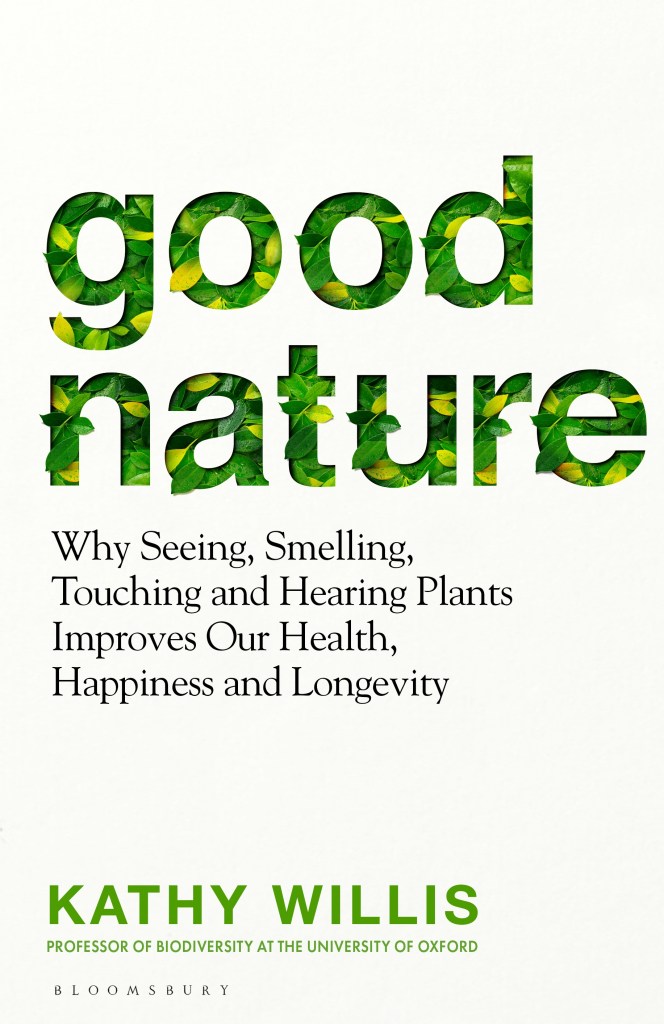
| Kathy Willis discusses with Ivan six things which should be better known. Katherine Willis CBE is Professor of Biodiversity in the department of Biology and the Principal of St Edmund Hall, University of Oxford. She is also a Crossbench Peer in the House of Lords. Previous roles include Director of Science at the Royal Botanic Gardens, Kew, and a member of the UK Government’s Natural Capital Committee. In 2015, Kathy was awarded the Michael Faraday Medal for public communication of science from the Royal Society. Her new book is Good Nature: The New Science of How Nature Improves Our Health. 1. Staring out of a window onto greenery instead of a brick wall or a general urban scene. Why? Because the view of greenery can trigger changes in our bodies that lead to a reduction in stress and improved cognitive performance (better attention to detail) when we return to the task we were undertaking before staring out of the window. 2. Having a vase of yellow or roses or houseplant with green-white leaves on your desk. Why? Because when we do so, clinical experiments indicate that even just viewing these plants on our desk can lower our blood pressure and make us less anxious. 3. Even if you only have 20 minutes for your walk or run, always head for the park/urban green space. Why? Because experiments show that there is a much greater reduction in our stress hormones (salivary amylase, cortisol and adrenaline) if we exercise in green space rather than on the streets. This stress relief is also found with sitting as well – so we don’t have to pound the pavements to gain these benefits. 4. Garden without your gloves. Why? Because experiments show when we do so the environmental microbiota (good bacteria) found in biodiverse environments, including organic soils, is transferred onto our skin and into our gut. In effect, our gut takes on the signature of the environmental microbiome that we are in. Why is this important? Because these bacteria are the same ones that have been shown to trigger all sorts of positive health outcomes (and we try to increase by drinking probiotic drinks etc). For example, experiments have shown that children and adults who garden without gloves and/or play in the soil, have a greatly increased diversity of these good microbes in their guts, and reduced inflammatory markers in their bloods when they do so. 5. Visit the Mediterranean garden at the Royal Botanic Garden, Kew. Why? Because this hidden gem at Kew has a whole host of health benefits associated with it due to the smells (volatile organic compounds) given off by the mediterranean herbs lavender, rosemary, and mint. When we smell the scent emitted these herbs, some of the compounds emitted by these plants pass across the lung membrane into our blood. Once in our blood they appear to interact with similar biochemical pathways to those found in some prescription drugs taken for anxiety, and various other anti-inflammatory effects. They also appear to affect brain wave activity associated with sleep. Lavender for example, is shown to result in triggering brain wave activity that results in longer intervals of deep sleep – whereas rosemary keeps us alert and awake. 6. Buy a diffuser and diffuse the scents of cypress trees in your home or office. Why? Because clinical experiments and field trials are showing that when we do so, not only are stress hormones reduced, but also it can trigger a significant increase of natural killer cells in our blood. These are the cells that attack cancerous cells and viruses, and ones that we really want in our blood to enhance our resilience to these non-communicable diseases that currently account for over 70% of deaths globally. (Just as an aside – a lot of the smells currently sold in supermarkets for diffusers do not have any known clinical health effects – I therefore buy via the internet Japanese hinoki oil and diffuse this – along with pine oil (which again has many anti-inflammatory health benefits). |
 Better Known